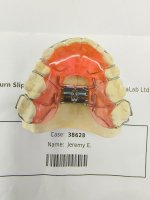
To begin with, Dr. Mew's claims make no sense for people over thirteen, because the midpalatal suture closes around that age and no plasticity remains that would respond to the pressure the tongue can place on the palate. Past that age, the only way to move the palate is with an expander anchored by TADs (temporary anchorage devices), that is, microimplants placed directly into the palate. It is not even possible to expand using molar bands, because the expansion produced would be alveolar rather than skeletal: after roughly thirteen years of age (it varies by individual, somewhere between twelve and fourteen) the suture fuses, and it cannot be reopened unless, to put it plainly, screws pass through the bones of the palate and break that fused suture.
That is the first point. The second point concerns extractions. Removing molars leaves the face looking completely flattened and detracts from a person's aesthetic appeal under any standard canon, particularly in the facial profile. This can be seen in the twin studies carried out by the elder Dr. Mew (the father), in which one twin was treated by expansion while the other went to a different orthodontist and had the molars extracted. You can clearly observe that one ends up with a very average face, bordering on unattractive, while the other is average bordering on attractive; and since they are identical twins, no other explanation is plausible.
Maxillary expansion must be anchored exclusively to the palatal bone to ensure that the expansion is purely skeletal. Procedures of this kind, particularly in adulthood, carry risks, since canting (a tilt of the occlusal plane) can occur, or other asymmetries can develop. Expansion must therefore be very controlled, strictly following the protocol.
It is also worth mentioning that in young children, below the age at which the suture fuses, the maxilla can even be expanded with removable appliances; and at those ages the pressure of the tongue on the palate does of course have an influence, because the suture has not yet closed.
In any case, it is absurd to expect that tongue posture alone could change an adult's palate by even a millimeter. At most it might act at the alveolar level, producing only a very slight change in the position of the teeth.